
Small-batch printing — how to run one
Logo, labels and cartons applied in the same factory that builds the hardware, from 50 pieces, with an artwork proof before the run starts. This page is the operating manual: which process suits which surface, what files we need, how the run is approved, and what it adds to the schedule.
To brand owners, distributors and project buyers,
Tittron — the B2B division of FlykanTech — invites you to put your name on the hardware in runs small enough to test: 50 pieces for silk-screening and laser engraving, a few hundred for printed cartons. The screens, lasers, pad printers and label applicators stand in the same plant that assembles your products, so there is no third-party print shop, no minimum that only a mature brand could justify, and no schedule lost to shipping parts out and back.
You approve a digital mock-up, then a physical sample, before a single unit is printed. Set-up is charged once and the per-piece price is quoted up front, so the cost of a 50-piece run is a figure you can weigh against the value of seeing your brand on the product — rather than a condition attached to a volume you are not ready for.
Send the artwork and the model you want marked. We will tell you which process suits the surface, when you will see the proof, and exactly what the run adds to your schedule.
The Tittron teamB2B division of FlykanTech · www.tittron.com
What the service actually solves
Branding usually comes with a trap: the logo is cheap, but the factory will only print it if you buy thousands. Small-batch printing removes that condition. Silk-screening, laser engraving, pad printing and labels are set up in the same plant that assembles the hardware, so a run of 50 pieces is a normal order rather than a favour.
The practical effect is that branding stops being a commitment and becomes a test. You can put your mark on 50 units, put them in front of a channel or a customer, and decide on the strength of that reaction whether the next run is 500 or 5,000. The artwork stays on file, so a repeat run does not start from zero.
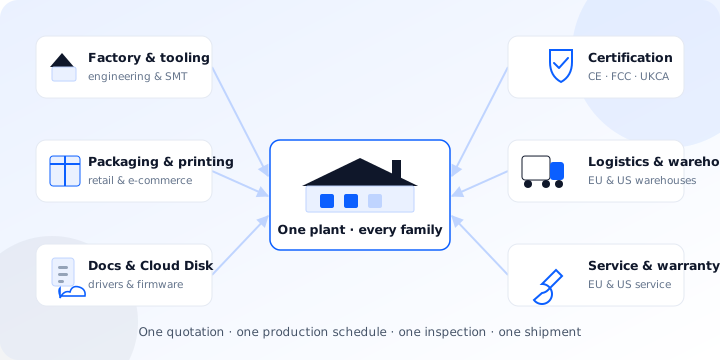
And because printing happens before packing rather than after delivery, the printed hardware, the retail carton, the manual and the compliance label all leave in the same shipment — one packing list, one inspection report, one arrival.
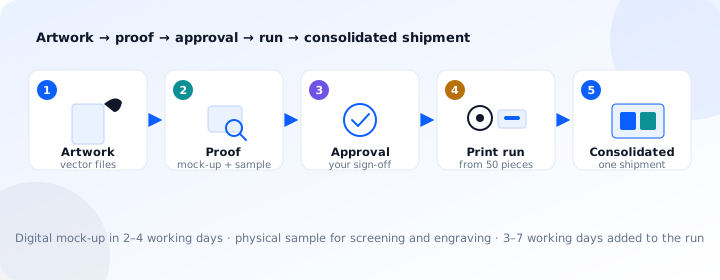
How a small-batch print run goes, step by step
Typical run: 50–500 pieces, approved proof before production starts.
-
01
Send the artwork
Send the logo and any brand rules. Vector files are best, but a clean bitmap is enough for us to redraw. Tell us the model, the surface you want marked and roughly how many pieces.
- AI, PDF or SVG preferred; PNG or TIFF at 300 dpi minimum at print size
- Pantone reference, or CMYK values with a printed sample
- Brand rules: minimum size, clear space, colours not to be used
-
02
Choose the process and position
We confirm which process suits the surface — silk-screen for flat housings and Pantone colour, engraving for a permanent mark on metal, pad printing for curved or recessed parts, labels for serial and compliance data — and where the mark can physically sit.
- Position checked against connectors, vents and screw holes
- Size checked against the smallest legible dimension of the process
- Same artwork can be applied to housing, carton and manual in one run
-
03
Approve the proof
You get a digital mock-up on a photo of the actual product within two to four working days. For screening and engraving we also produce a physical sample, because colour and depth do not read the same on a screen.
- Digital mock-up on the real product photo
- Physical sample for silk-screen and laser engraving
- One round of position or size adjustments included
-
04
Run and inspect
Production starts only after the proof is signed off. The first piece is checked against the approved sample, and adhesion and abrasion are checked against the agreed standard before the run continues.
- First-piece check against the approved sample
- Adhesion and abrasion checked on the agreed standard
- Set-up (screen or laser programme) charged once, per-piece price quoted up front
-
05
Pack and consolidate
Printed units go straight into packing — with the printed carton, the manual in your language and the compliance label — and leave with the rest of your order. Nothing is shipped out to a print shop and back.
- Cartons, inserts and manuals packed in the same line
- FBA or retailer carton marks applied on request
- Consolidated with unbranded models in the same shipment
What we need from you
| Artwork | Vector AI, PDF or SVG preferred; PNG or TIFF at 300 dpi minimum at print size |
|---|---|
| Colour | Pantone reference, or CMYK values with a printed sample to match |
| Fonts | Outlined or embedded; 4 pt minimum for print, 2 mm stroke minimum for engraving |
| Safe area | 3 mm from edges, holes, vents and connectors |
| Approval | Digital mock-up first, then a physical sample for screening and engraving |
| Proof lead time | 2–4 working days for the mock-up |
| Added lead time | 3–7 working days on top of hardware production |
| Minimum | 50 pieces per model for screening and engraving; cartons typically from 300 |
Send what you have — if the artwork is only a low-resolution bitmap, we redraw it as vector and send the file back for your records.
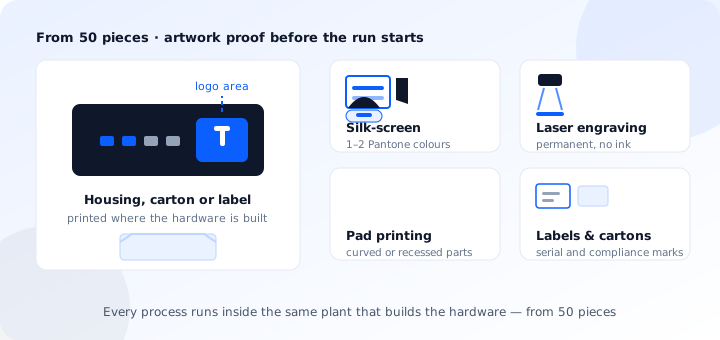
Which process suits which surface
All four run in the same plant, so a mix of processes on one order is normal.
Silk-screen printing
One or two Pantone colours applied to flat or gently curved housings, from 50 pieces. The right choice when the mark has to match a brand colour exactly and stay readable at small sizes.
Laser engraving
A permanent mark etched into anodised aluminium or plastic. No ink and no consumable, so there is no colour to fade and no screen to re-make for the next run.
Pad printing
For the places a screen cannot reach: round housings, recessed panels and connector bodies. Small logos and pictograms stay sharp on curved surfaces.
Labels and nameplates
Durable polyester or aluminium labels for model numbers, serial numbers, barcodes and compliance marks, applied on the line and exported as a list for your records.
Short-run cartons and inserts
Retail box, sleeve, blister or bulk carton printed from a few hundred pieces, with matching quick start cards and manuals in your language.
Three runs we do most often
Logo on the housing — from 50 pcs
Single-colour silk-screen or laser engraving on a docking station, KVM switch or converter housing. Digital mock-up first, physical sample before the run, unbranded models can sit in the same shipment.
Retail-ready pack — from 300 cartons
Printed retail box with your artwork, matching quick start card and manual, compliance marks for the destination market, FBA carton marks if the stock goes to Amazon.
Labelled and traceable — serialised
Polyester or aluminium labels carrying model, serial and compliance data, applied on the line, with the serial list exported so your own system can track every unit.
Who this invitation is for
Brand owners testing a market
Put your mark on 50 units, put them in front of a channel or a customer, and decide on that reaction whether the next run is 500 or 5,000.
Distributors needing their own label
Your name on the housing, the carton and the manual, with compliance marks placed for your market — without adopting a factory MOQ you cannot fill.
Project and installation buyers
Asset tags, serial labels and room markings applied on the line, with the serial list exported so your own system can track every unit.
E-commerce sellers
Retail-ready cartons, inserts and FBA carton marks prepared in the same run, shipped to your warehouse or straight into the fulfilment network.
What sits behind a print run
The same organisation that builds the hardware — which is why branding never forces a volume you do not need.
Printing inside the hardware plant
Screens, lasers, pad printers and label applicators sit in the same factory that builds the hardware. Parts are not shipped out to a print shop and back, which is what makes a 50-piece run economical in the first place.
Compliance marks done right
CE, FCC, UKCA and WEEE marks placed on the housing, the label or the carton according to the rules of the destination market, so the branded product clears without a repack.
Packaging engineering
Retail box, blister, bulk carton and e-commerce packaging engineered for transport and checked before the run, so the printed box survives the same journey as the hardware.
Logistics and market access
DDP or DDU to EU and US warehouses, FBA-ready labelling and carton marks, consolidated with the rest of your order — one shipment with or without branding.
Documentation and Cloud Disk
Manuals, quick start cards, datasheets and packing lists in your language, with drivers, firmware and certificates published for every model you brand.
Artwork on file, service after sale
Repeat runs reuse the approved artwork and screens, so the second order is faster than the first. Two-year warranty with EU and US service centres behind the printed hardware.
Commercial terms
| Quotation | Process recommendation and proof timeline within two working days; valid for 30 days |
|---|---|
| Set-up and unit price | Screen or laser programme charged once; per-piece price quoted up front |
| Proofing | Digital mock-up in 2–4 working days; physical sample before screening and engraving |
| Artwork custody | Vector files redrawn and returned to you; NDA on request |
| Payment terms | T/T in advance for first runs; terms reviewed from the second run onwards |
| Added lead time | 3–7 working days on top of hardware production, proofing runs in parallel |
| Compliance | CE, FCC, UKCA and WEEE marks placed according to the destination market |
| Repeat runs | Approved artwork and screens kept on file, so the second run is faster than the first |
Standard terms for a first print run. Set-up, tooling and repeat-run pricing are stated separately on every quotation, so nothing is hidden in the unit price.
What buyers ask before the first run
How small can a print run be?
50 pieces per model for silk-screening and laser engraving; printed cartons typically start at around 300 because of the plate and set-up cost. Below those figures the cost per unit stops making sense, and the quotation will show you where the break-even sits.
Do I have to print the whole order?
No. You can brand part of a consolidated order and leave the rest unbranded at its normal minimum — which is exactly how most buyers test a brand before committing to 500-piece private label runs.
What files do you need?
Vector AI, PDF or SVG is ideal; a clean PNG or TIFF at 300 dpi at print size works too, and we redraw it as vector. Add a Pantone reference or CMYK values, and outline the fonts. If something is missing we say so before proofing rather than after.
Can I see it before production starts?
Yes. A digital mock-up on a photo of the actual product arrives in two to four working days, and for screening and engraving we also make a physical sample. Production starts only after you sign off.
Will the print survive handling?
Adhesion and abrasion are checked against the agreed standard before the run continues, and the first piece is compared with the approved sample. Engraving is permanent; screened marks are cured and tested on the actual housing material.
Does printing delay my order?
Usually three to seven working days on top of hardware production. Proofing runs in parallel with the rest of the order, so the added time is the print run itself rather than the approval.
Let us quote your print run
Send the artwork and the model you want marked. You will receive the recommended process, a proof timeline and the set-up and per-piece cost — no obligation to proceed.